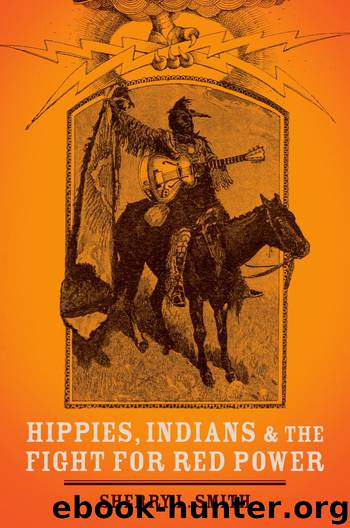
Hippies, Indians, and the Fight for Red Power by Smith Sherry L
Author:Smith, Sherry L.
Language: eng
Format: epub
Publisher: Oxford University Press, USA
Published: 2012-04-07T04:00:00+00:00
5
From Coast to Coast
In the early 1970s, interest in Indians spread far beyond the American West that spawned it. Native American activists took tactics put into practice at Alcatraz and fish-ins to the opposite end of the continent, even penetrating the heart of the nation’s capital. For the first time in the twentieth century, Indian affairs grabbed headlines nationwide as activists “invaded” or occupied patches of real estate from coast to coast and held demonstrations to call attention to issues ranging from land claims and treaty rights to sovereignty and self-determination. Furthermore, interest in Indians was no longer limited to the counterculture, radical fringe groups, or Protestant progressive groups. Indians became the subjects of influential, best-selling books such as Bury My Heart at Wounded Knee by Anglo librarian and writer Dee Brown and Vine Deloria Jr.’s Custer Died For Your Sins. Even Hollywood turned its attention to Native Americans, producing new kinds of Westerns with late twentieth-century political sensibilities. Films such as Soldier Blue and Little Big Man reversed the standard roles for Indian characters—cavalrymen played the villains to Native American heroes.
Through these mediums, people received new messages about Indians in a milieu of social, cultural, and political turmoil. Complaints about injustice from African Americans, Mexican Americans, and Native Americans gathered force and sometimes generated negative backlash. Overlaying it all was the deeply divisive war in Vietnam. The global implications of Americans’ treatment of minorities, particularly Indians, did not escape readers or moviegoers who understood they criticized not only the United States’ past imperialism but its current foreign policy, as well.
The books, the movies, the takeovers, or attempted takeovers, of Seattle’s Fort Lawton, Mount Rushmore, the Statue of Liberty, and the Bureau of Indian Affairs Building in Washington, D.C., came in a torrent. In fact, Paul Chaat Smith and Robert Warrior have adroitly characterized the period of Indian activism between Alcatraz and Wounded Knee as hurricane-like.1 Indian people were at the heart of the storm, providing its genesis, motivation, and energy. Non-Indians were swept up in the winds of change, drawing them into the currents, sometimes attracting and encouraging support, sometimes repelling. The Nixon White House could not ignore the tempest either—particularly when it touched down in Washington, D.C., in the fall of 1972, just days before the presidential election. Out of this confluence of forces came substantive change.
That change permanently put to rest termination of tribal governments and the trust relationship between them and the federal government, and helped advance the realignment of federal policy in a radically different direction. The Justice Department began to defend Indian treaty rights. Further, some demonstrations ended in remarkable victory. In Seattle, for instance, the United Indians of All Tribes (UIAT) succeeded where the Alcatraz occupiers failed. They received a lease to a chunk of the recently abandoned Fort Lawton military base and established an Indian cultural center, which exists to this day. Victory was not guaranteed, however. The Pit River Tribe, located in an isolated patch of northern California, did not prevail in their efforts to regain land.
Download
This site does not store any files on its server. We only index and link to content provided by other sites. Please contact the content providers to delete copyright contents if any and email us, we'll remove relevant links or contents immediately.
| Africa | Americas |
| Arctic & Antarctica | Asia |
| Australia & Oceania | Europe |
| Middle East | Russia |
| United States | World |
| Ancient Civilizations | Military |
| Historical Study & Educational Resources |
Cat's cradle by Kurt Vonnegut(15466)
Pimp by Iceberg Slim(14709)
4 3 2 1: A Novel by Paul Auster(12539)
Underground: A Human History of the Worlds Beneath Our Feet by Will Hunt(12171)
The Radium Girls by Kate Moore(12110)
Wiseguy by Nicholas Pileggi(5870)
The Fire Next Time by James Baldwin(5537)
Perfect Rhythm by Jae(5492)
American History Stories, Volume III (Yesterday's Classics) by Pratt Mara L(5348)
Paper Towns by Green John(5262)
Pale Blue Dot by Carl Sagan(5096)
A Higher Loyalty: Truth, Lies, and Leadership by James Comey(5030)
The Doomsday Machine by Daniel Ellsberg(4576)
The Mayflower and the Pilgrims' New World by Nathaniel Philbrick(4566)
Killers of the Flower Moon: The Osage Murders and the Birth of the FBI by David Grann(4497)
The Sympathizer by Viet Thanh Nguyen(4461)
Too Much and Not the Mood by Durga Chew-Bose(4404)
The Borden Murders by Sarah Miller(4402)
Sticky Fingers by Joe Hagan(4268)
